TMS Therapy
Transcranial magnetic stimulation (TMS) is a non-invasive treatment for depression that may help when medication alone hasn't provided the relief you need.

How TMS Works
TMS is unfamiliar to most people who consider it. Here is the whole of it in plain language — how treatment begins, and what happens once it does.
TMS at a glance
- Transcranial magnetic stimulation (TMS)
- A treatment that uses focused magnetic pulses to stimulate areas of the brain involved in mood.
- Non-invasive
- Nothing enters the body, and no surgery is involved.
- Mapping
- The step where your physician determines the placement and strength of your treatment, before a course begins.
- Treatment course
- The full series of repeated TMS sessions that makes up treatment, as opposed to a single visit.
- TMS physician
- The doctor who evaluates whether TMS is right for you and oversees your treatment.
Your treatment journey
Follow the four stages from your first call through ongoing treatment.
Getting started
Getting started is a phone call. What follows before any treatment begins is an evaluation and a look at the practical side.
Your first call
One phone call is all it takes to begin. That first contact leads to an evaluation with a board-certified psychiatrist — not to a treatment schedule.
Your evaluation
Your psychiatrist reviews your clinical history and talks with you about whether TMS may be appropriate for you.
Insurance review
Before treatment begins, our staff review your insurance coverage with you, so the practical picture is clear from the start.
Mapping
If TMS is appropriate for you, a mapping is scheduled with your physician to determine the placement and strength of your treatment.
During a session
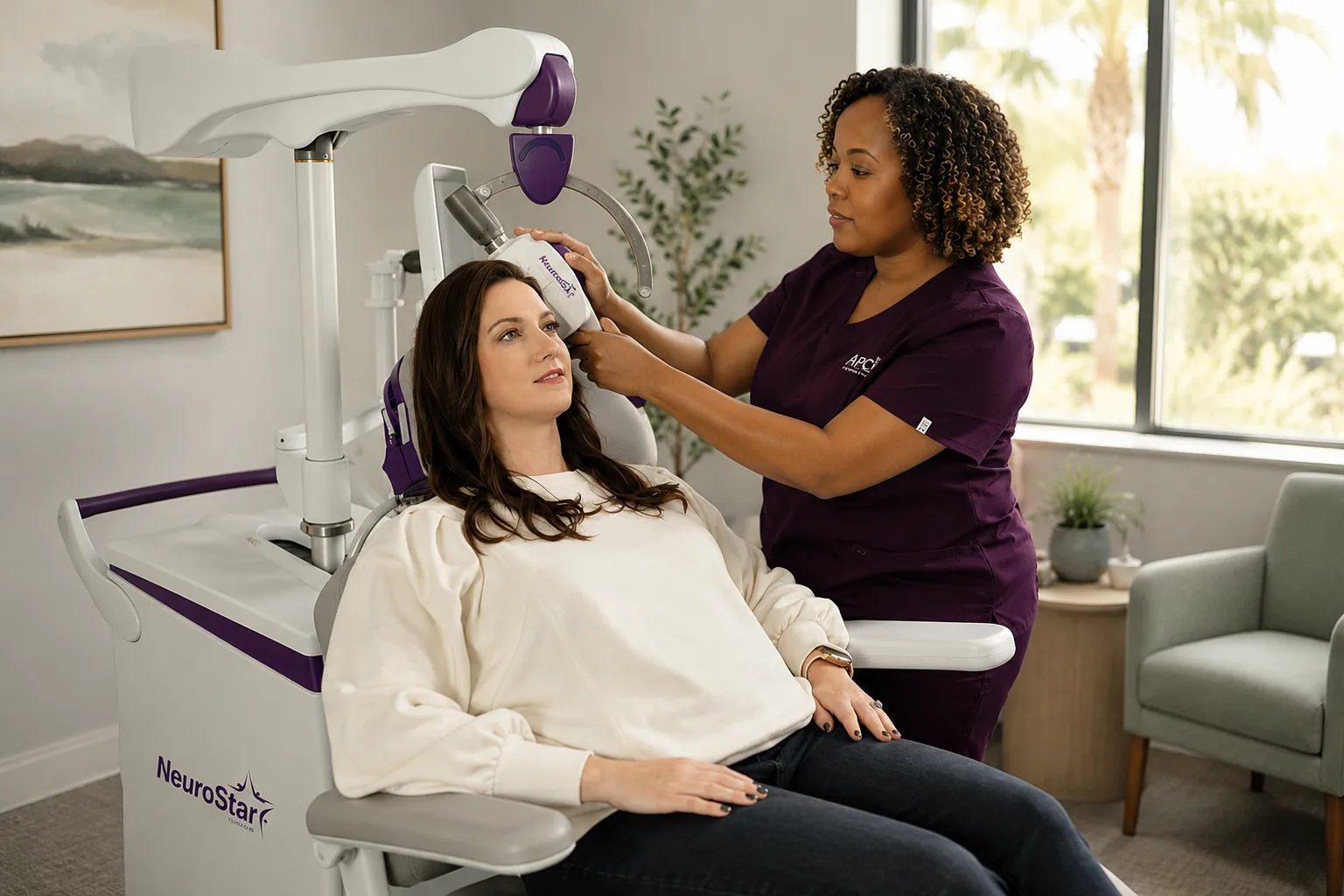
Treatment takes place in a dedicated treatment room at your office. You recline in the treatment chair and stay awake throughout — there is no anesthesia and no sedation — while a small, curved magnetic coil rests lightly against your head and delivers focused pulses to areas of the brain involved in mood. You’ll hear a steady clicking sound and feel a tapping sensation where the coil sits. Nothing is asked of you while it runs — patients read, watch television, or talk with the TMS team member in the room.
After & ongoing treatment
After a session
A session is an outpatient visit rather than a procedure to recover from.
A course of treatment
TMS is delivered as a course of repeated sessions rather than a single appointment. Those sessions are given by our TMS clinical team, working under the supervision of your TMS physician. How often sessions occur, and for how long, is part of your individual treatment plan.
Safety & side effects
Every treatment decision deserves a clear-eyed conversation about safety. Your TMS physician will discuss safety considerations and possible side effects with you before treatment begins.
Evidence behind TMS
TMS for depression has been studied in randomized controlled trials, which compare it with a sham — an inactive stand-in procedure — and in large studies of patients treated in everyday clinical practice. These four are the studies Atlantic Psychiatric Centers has cited on its TMS pages; each links to its record on PubMed, the U.S. National Library of Medicine’s research database.
Your TMS physician can talk through what the research does and does not mean for your own situation.
- 2007 · Randomized controlled trial
A double-blind, multisite trial comparing active TMS with a sham procedure in patients with major depression who had not benefited from prior treatment.
Efficacy and safety of transcranial magnetic stimulation in the acute treatment of major depression: a multisite randomized controlled trial. O’Reardon JP, et al. Biological Psychiatry.
View on PubMed - 2010 · Randomized controlled trial
A sham-controlled trial of daily TMS for major depressive disorder, carried out at four U.S. university hospital clinics.
Daily left prefrontal transcranial magnetic stimulation therapy for major depressive disorder: a sham-controlled randomized trial. George MS, et al. Archives of General Psychiatry.
View on PubMed - 2012 · Study in clinical practice
Followed outpatients with major depression, whose symptoms had persisted despite antidepressant medication, through TMS treatment at 42 U.S. clinical practices.
Transcranial magnetic stimulation (TMS) for major depression: a multisite, naturalistic, observational study of acute treatment outcomes in clinical practice. Carpenter LL, et al. Depression and Anxiety.
View on PubMed - 2014 · One-year follow-up study
Followed patients from 42 clinical practices for a year after an acute course of TMS, to assess its longer-term effectiveness.
A multisite, naturalistic, observational study of transcranial magnetic stimulation for patients with pharmacoresistant major depressive disorder: durability of benefit over a 1-year follow-up period. Dunner DL, et al. The Journal of Clinical Psychiatry.
View on PubMed
Insurance & practical questions
Atlantic Psychiatric Centers accepts a range of major insurance plans, excluding Medicaid. Coverage varies by plan and provider. Call Atlantic Psychiatric Centers at 321-724-1614 to confirm your coverage.
TMS coverage also depends on your plan’s own eligibility requirements, which vary from plan to plan. The same call will confirm what your plan covers for TMS and what it asks for beforehand.